Tag: THC

The Difference Between Delta-8 and Delta-9 THC… What You Should Know

It seems that we are constantly running into new forms of CBD or THC that we need to learn about. Back in the 1970s, there was a big push to learn more about THC and therefore learn about the different types of THC that could be created or discovered.

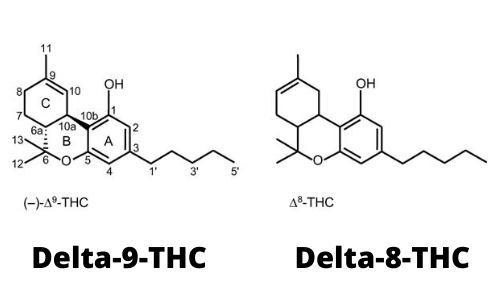
Now we have quite a number of THC variations: Delta-8, Delta-9, THC-P, THC-O, THC-V, and the list goes on. I know that all of these things can get confusing, but today I wanted to talk about Delta-8 and Delta-9 specifically, mostly because these are the ones that are most commonly used in the United States today. Delta-8 is an especially hot topic in the United States right now, since it is technically considered CBD but also can get you high.

You see, the reason that CBD has been legalized by the federal government is because it does not inherently contain any THC. Since it is technically derived from hemp, it has become completely legal across the nation. But what is Delta-8 then? Well, I am going to be talking about all of this today in this article, so make sure that you keep reading if you want to learn more. Anyone who has smoked their fair share of weed could tell you about a THC high that we associated with Delta-9.

Of course, the high you get can differ depending on the strain of marijuana that you use, but most are somewhat similar to each other. You get that nice warm feeling in your brain, your body starts to tingle a bit, you feel happy and giggly and relaxed: it’s all just a great time. But have you ever been a little disappointed after getting high? Sometimes it can be frustrating to come down from a high and realize you have no idea what happened for the last couple of hours.
You couldn’t really focus on anything or get anything done, you simply just vibed for a bit. While that can be a fun pastime, it is not necessarily a sustainable practice for people using medical marijuana every night to treat certain health conditions. Plus, Delta-9 THC is not legal in every state. However, this is where Delta-8 can come in.

As I said before, Delta-8 is technically considered CBD. It’s basically a loophole in the federal government’s law against THC products nationwide. But Delta-8 is still different from other types of THC, and noticeably so. Some people prefer using Delta-8, while others say that it pales in comparison to the classic Delta-9 THC that they know and love.

Either way, I think it is important to at least give Delta-8 a try and decide for yourself. Like I talked about before, Delta-9 THC can really impair your ability to think clearly, function, or even converse with people. You kind of just float for a bit. Delta-8, in comparison, is a type of high in which one still has a lot of control. People that regularly use Delta-8 definitely feel its effects, but they don’t feel completely impaired from doing things or thinking.

For some people, this is a huge benefit. Don’t get me wrong – Delta-8 definitely makes you feel intoxicated to where you shouldn’t drive or do things like that, but it is not going to be as intense as a Delta-9 high. Some research suggests that Delta-8 THC could actually be better for the brain in the long run. It is said that adults who use large doses of THC daily will see changes in their brain overtime. Delta-9 THC can cause a reduction in brain tissues in the prefrontal cortex, but this is only for very chronic users of the drug.
What You Need to Know About CBD Gummies

What is the difference between CBD and THC? Is there a difference at all? Can you have one without the other? All of these questions and more will be answered in this article today. First off, I want to talk about the difference between CBD and THC. Cannabidiol, also known as CBD, is one of the main chemical components derived from the cannabis plant.

CBD is often associated with more medicinal uses of cannabis, especially for lowering levels of inflammation and increasing overall mind and body wellness. On the other hand, THC is the part of the cannabis plant that actually gets you high. The difference is important to distinguish because, depending on the state you live in, you may or may not have access to both. CBD has actually been legalized on a federal level in the United States, meaning that it is available for purchase in every state.

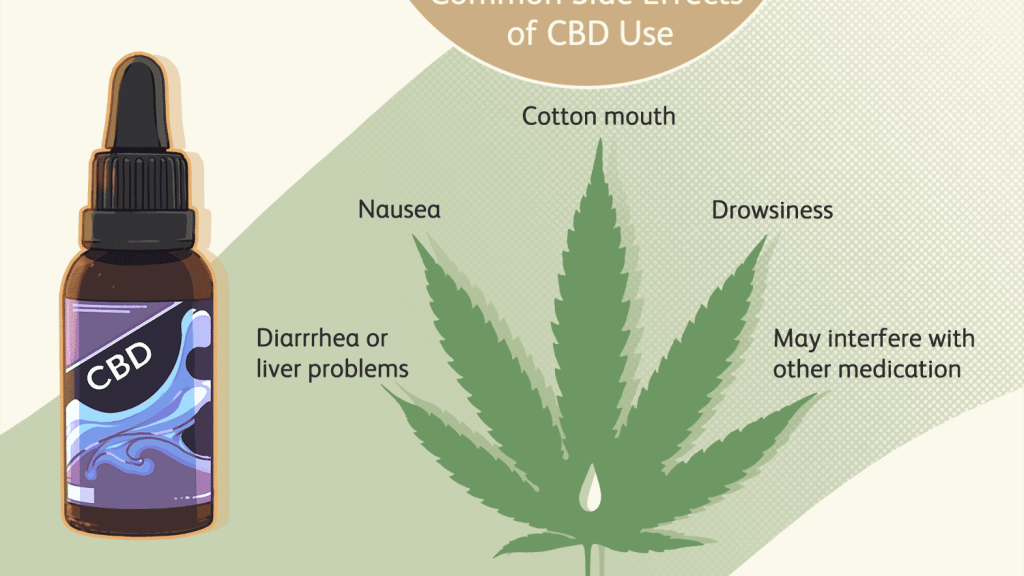
If you are wanting to try out using cannabis to treat certain health conditions but do not live in a state that has legalized weed with THC, CBD might be your best bet. I say this because I wanted to talk more about CBD gummies and some things that you should know about them. CBD products, as I just mentioned, are widely available in the United States and offer a number of health benefits for medical patients and regular consumers alike. But before you go and buy some CBD gummies for yourself, here are some things you should know about taking these supplements. 

The first thing that I want to say about CBD gummies is that they taste good. When people think about using some sort of cannabis edible, they probably picture eating that disgusting pot brownie from back in their high school days. Today’s marijuana products are much more advanced and effective than anything you may have had in your earlier years, especially considering that CBD products are now made in sophisticated labs rather than your friend’s basement.

In many cases, you would not even be able to tell the difference between CBD gummies and regular candy. It doesn’t taste or smell like cannabis, and you definitely won’t stink up a room by opening a pack of CBD gummies in public or something like that. Many people enjoy using CBD gummies because of how convenient and discreet they are. Also, you can find CBD in liquid form that can be flavored or unflavored. People like to be unflavored CBD drops and put them in their morning coffee or pre workout. Honestly, you can’t really go wrong with some CBD edibles, especially with something like gummies. 

Another thing that I want you to know about CBD gummies is that they are actually effective, especially when it comes to helping with inflammation. Most chronic diseases, and the subsequent pain that they can cause, are caused by some form of inflammation at a cellular level. When CBD is brought into the mix, it may be extremely helpful at lowering levels of inflammation and reducing your levels of pain and discomfort as well.

There are tons of problems that are associated with long-term inflammation, including memory impairment, cholesterol imbalance, elevated CRP levels, aches and pains, skin problems, and digestive issues. Overall, inflammation is something that you want to prevent and treat if at all possible, and CBD may be able to help with that.

You can also find cannabis products that have both CBD and THC in them. Honestly, I think that this is the way to go if you live in a state that allows for it. THC will allow you to experience more euphoric effects from the gummies and make the whole experience better.

All about Dronabinol

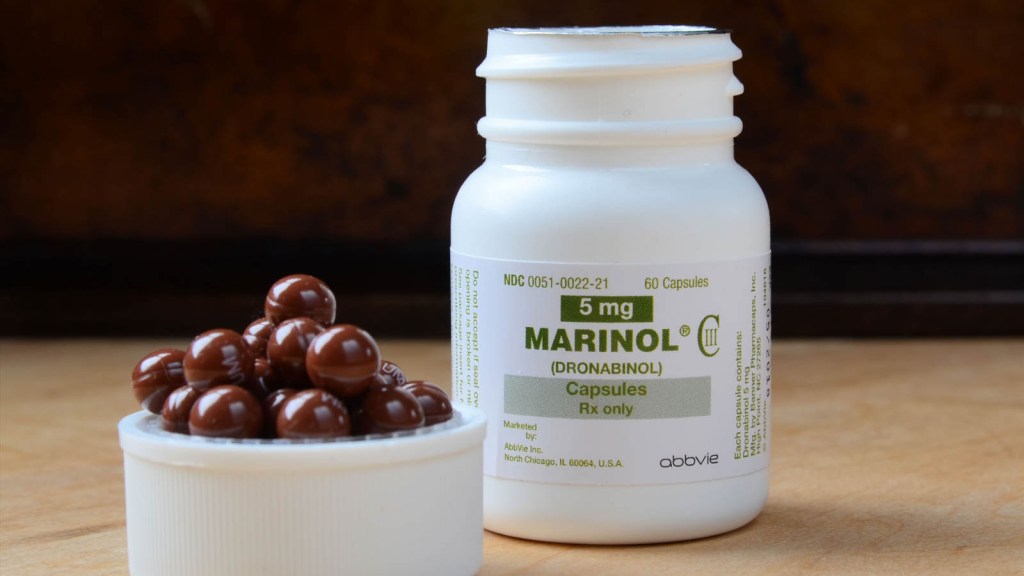
Dronabinol is a cannabinoid that’s synthetic and is used as a medication to help with nausea and weight loss symptoms in those with cancer along with HIV treatments. It’s basically synthetic THC that doesn’t contain anything else. It also is known as Marinol as well, which is a cannabinoid that’s synthetic, and it works to control vomiting and nausea. Being synthetic, it just contains one compound and that’s THC, something that’s in cannabinoids.  Dronabinol is pretty simple, since it does work alongside the same THC receptors that are within the body and what the plant uses, and it offers a way to curb nausea, to stimulate your appetite. 

This treats cachexia which is a wasting disease, but also helps those with AIDS and HIV.  It also is used to help with appetite loss and nausea in chemotherapy patients. It’s the same as THC, and it’s something that’s more potent and synthetic, and also is an alternative to nabilone for those who are interested in using something stronger. 

Dronabinol or THC? 

When you’re looking to see if you should use one or the other, it’s important to note that they’re not the exact same, even though they both contain THC. 

Dronabinol is something that’s synthetic and approved by the FDA for the treating of some people’s conditions.  Regular THC is a naturally-occurring compound in cannabis and is only availible to those who are in places where it’s legal.  Dronabinol is something that’s schedule III drug types, whereas in contrast, THC is a schedule I substance, similar to cocaine. 

Dronabinol has a formula that works similar to how THC does on the body. but the generic dronabinol is one that’s similar to THC cannabinoids, but in contrast, THC does interact with the other cannabinoids, and then constituents within the plant itself, and from there, all of this working together makes an entourage effect. 

Medical cannabis in contrast to this, doesn’t just contain THC, but also contains other types of phytic cannabinoids and terpenes as well, so you’re getting more than just THC. 

How it helps 

Dronabinol is only used for the two conditions above, and the nausea does have to be severe for them to prescribe it. And there are some promising results for a few of the major conditions 

For example, it helps immensely with sleep apnea.  It actually was found in a 2018 study that it does reduce the symptoms of this, improving the awakens in a trail which was randomized. It showed that it wsa better for those who took it in terms of sleep outcomes. 

Pain is another thing. Some research has found that dronabinol is a really good way to relieve pai post-surgery, pain that isn’t cancer, or neuropathy.  Only in noncancer pain that was chronic did it only show modest results compared to the placebos used. It was found however that there were benefits which are promising for those are looking to treat lower-back pain and MS in those who have it, especially compared to vaped cannabis. 

As for MS, it was found that it could be useful for this, and while the exact ways to relieve this pain are not fully resolved, it was found that there is a chance that long-term pain can be relieved like this. It also was found that “Sativex,” another cannabis prescription, can help. 

Finally, it’s a good one to use when treating Alzheimer’s disease in some cases, showing some promising results with it. It could treat symptoms of agitation associated with this, and also, may helps with the pastimes that come with Parkinson’s as well for patients. 

CBD and the pain relationship 

Pain is super complex based on the experiences of individuals. Our biology, the environment we’re in, and experiences of the past do involve and influence the perception that we have to pain as well, and sometimes, it’s not that easy to treat. With chronic pain and the management also being a controversy, since opioid pain and medications can be detrimental, one way to fix this is another alternative. CBD and cannabis are those which are currently involved to fight the pain receptors. 

Cannabis and Using it for Pain 

There is constant legal pressure within the US and Europe to accept cannabis as a way to treat pain. THC and CBD are definitely two of the main compounds, with THC receiving most of the focus, but this is indeed changing. 

CBD and pain are constantly changing, and there are so many studies that are done to understand the efficacy of this, with most of the studies so far being performed on different animal models and their pain. most of this is centered around your endocannabinoid receptors. 

These are of course the receptors that humans and mammals all have, and they consist of different receptors that do interact with those cannabinoids within the body. This has so many different effects and profiles, all of which are a part of the ECS. 

With the endocannabinoid system being more popular than ever before, and humans and mammals utilizing this within the body, and over 100 different cannabinoids with different effects and profiles, all of these do interact with one another. Metabolism, mood, appetite, pain and anxiety, all of these are a result of the endocannabinoid system. 

So can CBD help 

While CBD is not psychotropic, it does work with the neurotransmitters of thew body. in a study done in 2015 examining the way CBD can influence your ECS through increasing the anandamide levels, this works to reduce pain, and improves you mood. 

Then, there was a study which was published in May of 2019 that also examined the relationship that CBD and THC had with chronic pain. in this study, it looked at how tolerated the safety of a mouth spray which had cannabinoids would be, and they were add-ons to natural products for patients who had severe pain that was chronic. 

Studies on This 

It was found that this is one of the most effective treatments for both mental and physical health. One study involving inflammation looked at the impact that oxidative stress and inflammation had via the mechanisms of the ECS, and while it was inconclusive, it does set up for more in-depth and interesting research from this. 

Arthritis is another. With over 60 million adults suffering from this, and over 100 different conditions and effects, it makes sense that this is something that does offer varieties of motion. In a study that was done in 2016, they gave the rat some arthritis medications and CBD, and they looked at this. They didn’t see a ton of changes, but it could help. 

Finally, there is neuropathy, which includes a lot of sensitivity, pins and needles, and in some cases, excruciating pain. in a review from 2018, it looked at the potential harm that THC and CBD had when it came to pain, and it found that there were people who used this, and talked about the effects of cannabis, especially on certain problems. 

So there are studies, and while it does help, there isn’t anything super conclusive yet, so definitely keep that in mind if you decide to use, and also factor that in too when treating various pain.